
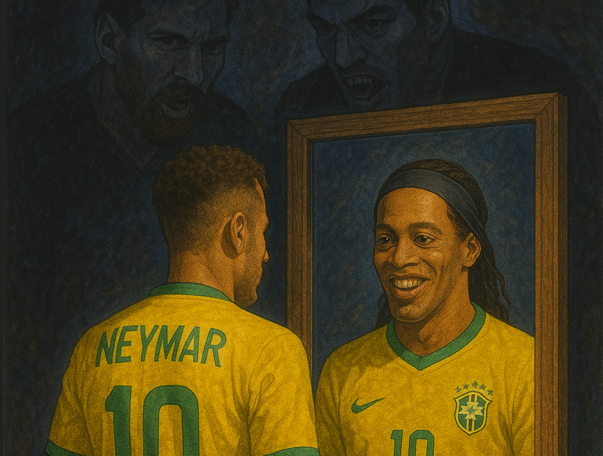
A Legacy Written in Shadows :Neymar Jr
In the pantheon of football, few players have danced closer to greatness only to have it slip through their fingers like Neymar da Silva Santos Júnior. Once hailed as the heir to Brazil’s footballing throne, Neymar was supposed to lead his country and his generation into a new golden era. He dazzled, inspired, and sometimes even outshone the stars around him. But somewhere between Santos and Paris, his story changed.
And in the footnotes of his unfulfilled promise, two names stand tall—not as rivals, but as comrades who unknowingly kept the spotlight just out of his reach: Lionel Messi and Luis Suárez.

The Barcelona Dream
When Neymar arrived at FC Barcelona in 2013, he joined a team that already had the greatest player in the world. But instead of clashing with Lionel Messi, he found harmony. The arrival of Luis Suárez in 2014 completed the attacking trident that would become known as MSN.
Together, they were unplayable. The 2014-15 season saw them score 122 goals. Neymar wasn’t a sidekick—he was part of the most feared front three in football. Yet, even in moments of brilliance, he was always third in line for glory.
Messi was the icon, the genius, the eternal. Suárez, with his ferocious appetite and game-changing presence, became the warrior, the indispensable number nine. Neymar? He was the flair, the entertainer, the prince. But rarely the king.
Chasing the Throne
By 2017, Neymar had grown tired of playing in someone else’s orchestra. He craved more than assists and smiles—he wanted the Ballon d’Or, the World Cup, the spotlight that could finally make him “the man”.
So he left.
His €222 million move to Paris Saint-Germain wasn’t just a transfer—it was an exodus. Neymar was leaving Messi’s shadow to build his own empire. The money, the glamour, the promises of leadership—it all pointed to a player stepping into destiny.
But destiny, as it turned out, had other plans.
The Fall in Paris
Injuries, ego clashes, and inconsistency marked his time in Paris. Though brilliant in flashes, Neymar never found the clarity or dominance he sought. Mbappé rose through the ranks, and even in a team built around Neymar, he somehow found himself overshadowed again.
Then came 2021—the twist that felt like a cruel joke. Messi joined PSG.
The king returned. The throne Neymar had chased, the autonomy he had longed for, was suddenly gone again. His closest friend became, once again, the world’s favorite.
From being the face of a project, Neymar was now part of an ensemble. The cycle repeated.
What Could Have Been
Neymar’s downfall is not one of failure—his talent remains transcendent, and his career is decorated with trophies, unforgettable goals, and moments of genius.
But in a narrative sense, he never ascended to the level expected of him. Not because he wasn’t good enough, but because he never had a stage entirely to himself.
He had the world at his feet, but his stage was always shared—first with Messi, then with Suárez, then again with Messi.
The Price of Greatness
Neymar was born to be great. But football, like history, is rarely fair. In chasing a crown, he became a symbol of unfulfilled greatness. Not a tragedy, but a tantalizing “what if.”
He will go down as one of the most talented players of his era. But the prince, in the end, never became the king—because the kings he played with were just too great to dethrone.